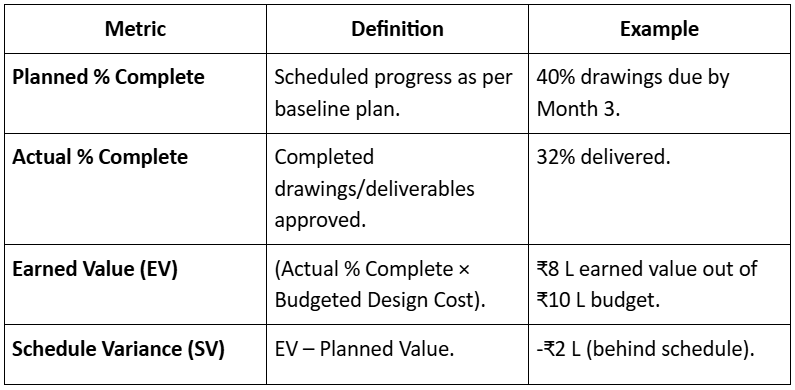
Unlike physical construction, design progress is intangible — measured in deliverables, not cubic meters or tons.
Accurate tracking ensures the timely issue of drawings and prevents construction delays.
1. Design Progress Metrics
2. Tracking Mechanisms
- Maintain a Design Deliverable Register (DDR) listing all drawings, statuses, and approval dates.
- Conduct weekly design coordination meetings.
- Use traffic-light dashboards (Green = on track, Amber = delay risk, Red = critical).
- Integrate design progress into the Master Schedule (MSP/Primavera).
3. Managing Revisions and Change Control
- Log all Revisions (R1, R2, etc.) with reason codes.
- Assess cost and schedule impact before issuing revised drawings.
- Maintain a Change Control Register linking changes to approvals.
“You can’t manage what you can’t measure — even in design.”
Module Summary
- Design development transforms concepts into executable plans.
- The Project Execution Plan (PEP) governs coordination, cost, and control.
- Mini-drawings simplify reviews and fast-track execution.
- Proper design budgeting ensures resource efficiency and accountability.
Measuring design progress through EV and DDR prevents downstream delays.