The Work Breakdown Structure (WBS) is the foundation of all project planning. It defines the “what” of the project — breaking down large, complex work into smaller, more manageable parts.
Definition
“A hierarchical decomposition of the total scope of work to be carried out by the project team to accomplish the project objectives and deliverables.” — PMBOK®
Purpose of WBS
- Clarifies scope and deliverables.
- Establishes the basis for scheduling, cost estimating, and resource planning.
- Enables better monitoring, accountability, and reporting.
- Prevents scope creep and duplication of work.
Structure of a WBS
A WBS is hierarchical, typically using 3–5 levels:
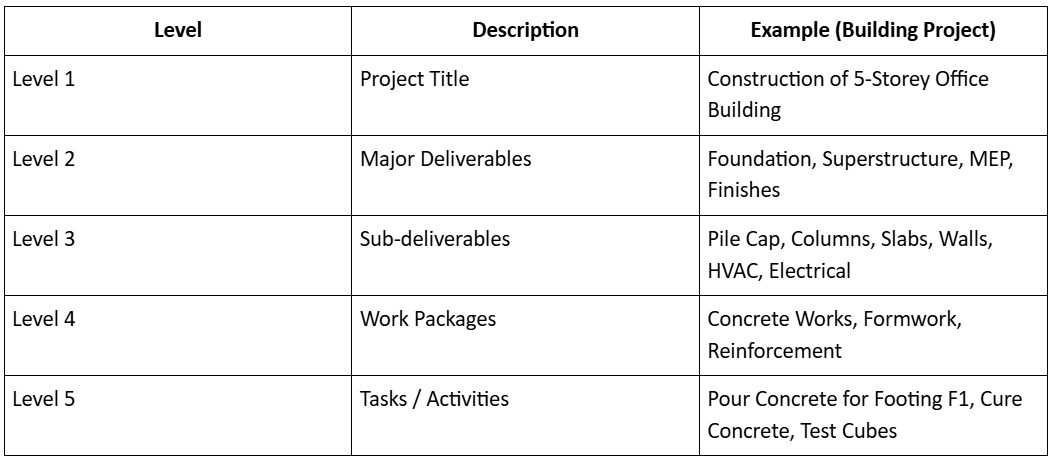
Types of WBS
- Deliverable-Based WBS – Focused on what needs to be delivered.
- Phase-Based WBS – Organized by project stages (Design → Procurement → Construction → Handover).
- Hybrid WBS – Combination of deliverables and phases (most common in construction).
“If you can’t measure it or schedule it, it’s not properly defined in your WBS.”